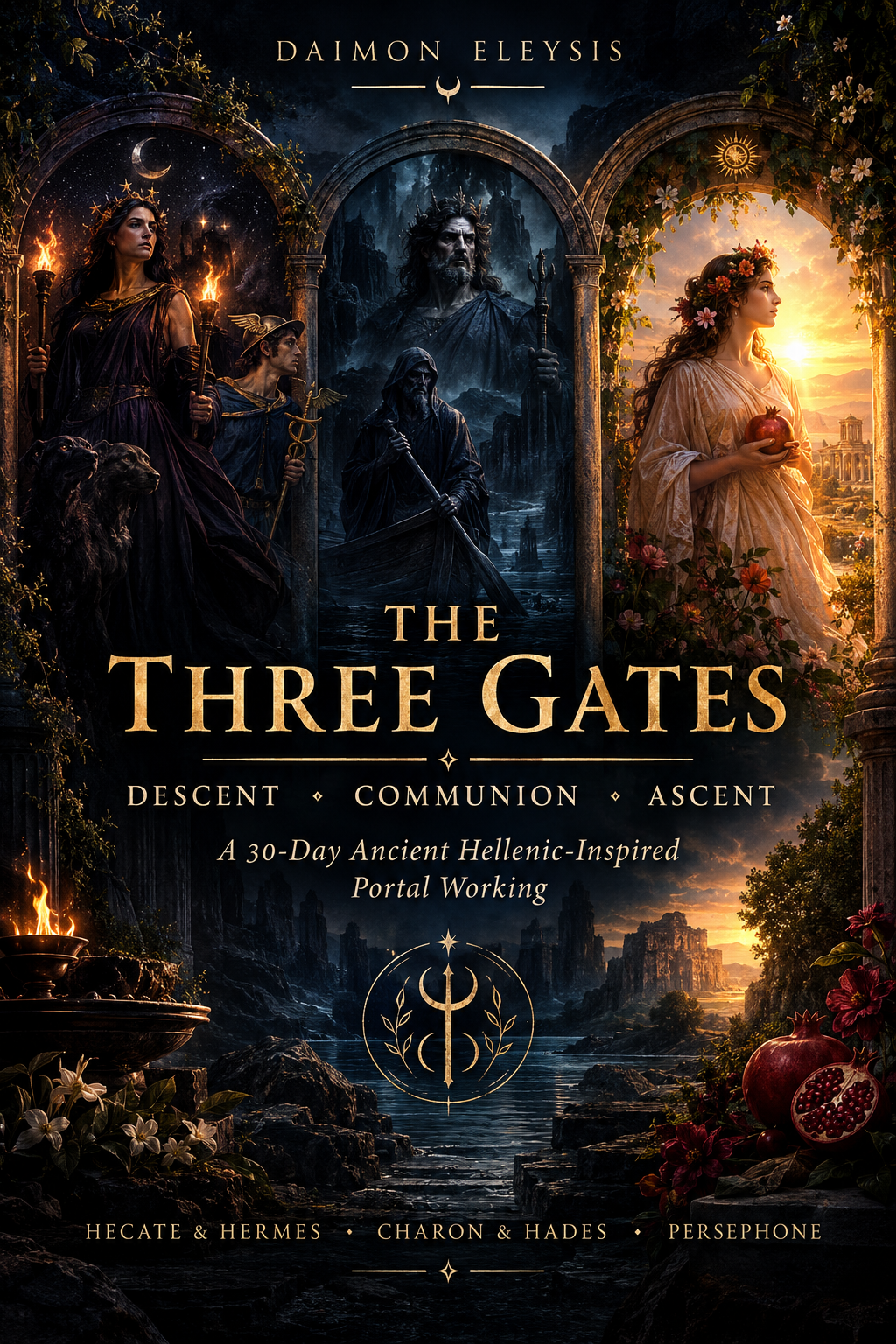

A Journey Through the Underworld and Back into the Light
An Ancient Hellenic-Inspired 30-Day Portal Working by Daimon Eleysis
There are journeys that lead us across the surface of the world, and there are journeys that lead us beneath it. The latter do not necessarily require us to leave the place where we stand. They ask something far more difficult: that we turn our attention toward the hidden dimensions of existence, confront what has remained unexamined within ourselves, remember those who came before us, and explore the ancient boundary between the living and the dead.
In the spiritual imagination of Ancient Hellas, the Underworld was not merely a place of darkness. It was a kingdom governed by its own laws, a destination beyond the reach of ordinary human life, and a realm in which the mysteries of mortality, memory, destiny, and transformation acquired their deepest significance. Its rivers marked boundaries that could not be crossed casually, its gates separated different conditions of existence, and its divine rulers embodied powers that demanded reverence rather than conquest.
The journey into this realm was never complete through descent alone. One had to find the way back.
The Three Gates: Descent, Communion, Ascent is a 30-day spiritual working created by Daimon Eleysis around this fundamental principle. Inspired by Ancient Hellenic mythology and the symbolism of the Underworld, it presents a structured journey through three distinct stages: approaching the threshold, entering the realm beyond it, and returning to the world of the living with the meaning of the experience integrated into ordinary consciousness.
This is not simply an exploration of darkness. It is an exploration of what darkness may conceal, what remembrance may restore, and what the return to light may reveal.
I. The Underworld as a Spiritual Landscape
The Underworld occupies a distinctive position in the Ancient Hellenic understanding of existence. It is associated with death and separation, but also with mysteries that cannot be understood through appearances alone. Beneath the visible world lies the invisible; beyond the familiar lies the unknown; and beneath the conscious mind lies a vast territory of memories, fears, inherited patterns, unresolved emotions, and unrecognized possibilities.
These dimensions are not identical, and the mythological Underworld should not be reduced to a psychological metaphor. Nevertheless, its imagery offers a powerful language through which a modern practitioner may approach the experience of confronting what is hidden.
In this symbolic landscape, descent becomes an act of attention. It represents the willingness to approach subjects that are often avoided: grief, mortality, forgotten memories, ancestral identity, the parts of the self that remain difficult to understand, and the questions that continue to return even when everyday life demands that we ignore them.
The darkness is not automatically an enemy. Neither is everything hidden necessarily a source of wisdom. The task is to approach the unknown with discernment, respect, and a clear understanding of one's own boundaries.
This distinction is central to the philosophy behind The Three Gates.
Rather than presenting the Underworld as a place to be conquered or its inhabitants as powers to be commanded, the working adopts an attitude of respectful approach. The unknown is approached with humility. Silence is allowed to remain silence. Experiences are recorded and considered rather than immediately accepted as unquestionable truths.
Through this approach, the Underworld becomes a landscape of contemplation, spiritual symbolism, and personal discovery.
II. Why Three Gates?
The number three appears throughout Ancient Hellenic mythology, religious symbolism, and philosophical imagination. It evokes movement between distinct conditions, the relationship between beginnings and endings, and the possibility that transformation requires more than a single decisive act.
The Three Gates draws upon this sense of progression through three interconnected movements.
The first gate is Descent. The second is Communion. The third is Ascent.
Together, they form a complete symbolic journey.
Descent without communion would be an entrance without purpose. Communion without ascent would leave the journey incomplete. Ascent without reflection would risk turning the experience into something that is quickly forgotten, rather than something that can be understood and carried into life.
The three stages therefore serve different purposes while remaining inseparable from one another.
The practitioner first approaches the threshold, then enters the central mystery of the journey, and finally turns toward restoration, integration, and closure. Each stage has its own mythological atmosphere and spiritual emphasis.
This progression distinguishes The Three Gates from a collection of unrelated invocations or isolated devotional practices. It has a defined beginning, a middle, and an ending, with the entire thirty-day period organized around the relationship between these movements.
The purpose is not simply to look into the darkness. It is to understand the significance of the descent and to complete the return.
III. Hecate and Hermes: Guardians of the Threshold
Every journey into unfamiliar territory begins at a boundary.
In Ancient Hellenic mythology, Hecate and Hermes occupy especially meaningful positions in relation to thresholds, roads, transitions, and the movement between worlds.
Hecate, associated with crossroads and the mysteries of the night, is a fitting presence at the beginning of a journey into the unknown. Her torches illuminate what would otherwise remain obscure, while her keys evoke the power to open and guard passages. She is not merely an image of darkness, but a goddess associated with the threshold itself: the point at which one direction ends and another begins.
Hermes, in his aspect as Psychopompos, is the guide who accompanies souls. His mythological role connects him with passage, communication, and the movement between different domains of existence. He is a divine intermediary, a figure whose significance lies in his ability to navigate boundaries that separate other beings.
Within The Three Gates, Hecate and Hermes establish the mythological foundation of the first stage, the Descent.
Their combined symbolism represents two complementary qualities. Hecate evokes the guarded threshold and the light required to approach it; Hermes evokes guidance, movement, and communication across boundaries.
For the practitioner, this stage introduces the themes of preparation, self-awareness, and the establishment of a respectful relationship with the spiritual landscape of the working.
It also introduces an important principle: approaching the unknown does not require abandoning one's judgment. The presence of divine guides within a spiritual framework does not eliminate the need for personal responsibility, discernment, or an awareness of one's limits.
The threshold is not simply something to cross. It is something to approach consciously.
IV. Charon and Hades: Entering the Kingdom Beyond the River
The second gate leads into the central landscape of the working: the Underworld itself.
Few images in Hellenic mythology communicate the boundary between life and death as powerfully as the river crossing associated with Charon, the ferryman of the dead. The river represents a separation between different conditions of existence, while the ferryman embodies the passage through that boundary.
Charon is not a decorative figure placed within an imagined journey. His role gives the central stage its mythological gravity. The crossing signifies a transition from approaching the mystery to entering into its symbolic domain.
Beyond the river stands Hades, ruler of the Underworld.
Hades is frequently misunderstood when viewed exclusively through the lens of later images of death and infernal punishment. In the Ancient Hellenic mythological world, he is a sovereign deity whose kingdom forms part of the larger cosmic order. His domain is associated with the dead, the hidden, and that which lies beyond ordinary human possession or control.
His authority establishes the character of the second gate. The Underworld is not treated as a territory without order, nor is communion presented as an entitlement. It is approached through the symbolism of permission, respect, and recognition of boundaries.
This stage is particularly relevant to those interested in ancestral remembrance, the spiritual meaning of death, and the exploration of the unseen through an Ancient Hellenic framework.
It also offers a contemplative setting for questions that do not always receive attention in everyday life.
What remains of a person in our memory after death? How do family stories shape the identities of later generations? What do we carry from those who came before us, whether consciously or unconsciously? How might we approach grief without allowing it to erase the value of remembrance?
These questions do not require supernatural certainty to possess significance. They touch upon the human relationship with mortality, continuity, identity, and the need to give meaning to loss.
Within the spiritual framework of The Three Gates, the middle stage is devoted to the themes of communion, remembrance, and guidance. It provides space for the practitioner to reflect upon ancestors, departed loved ones, and the questions associated with the invisible dimensions of existence.
The working also incorporates the traditional mythological imagery of Lethe, the waters associated with forgetfulness. In this context, Lethe evokes the relationship between memory and oblivion, between the preservation of identity and the possibility of being forgotten.
Remembering the dead becomes more than an act of looking backward. It becomes a way of acknowledging that human lives leave traces in the living world: in family histories, relationships, inherited values, personal memories, and the stories that continue to be told.
The second gate therefore stands at the heart of the entire journey. It is the point at which the practitioner encounters the deepest themes of the working and considers what remembrance, silence, and the search for meaning may reveal.
V. Ancestral Remembrance and the Ethics of Communion
The desire to connect with those who have died is among humanity's oldest spiritual impulses. Across cultures, people have preserved the names of their ancestors, maintained memorial traditions, spoken to departed loved ones, and created sacred spaces in which the dead remain part of the community's memory.
Ancient Hellenic traditions also included practices of honoring the dead and maintaining relationships of remembrance with those who had passed beyond mortal life.
The Three Gates approaches this subject through a framework of respect rather than domination.
The dead are not presented as servants to be compelled into obedience. Nor is spiritual communion framed as an opportunity to demand answers regardless of circumstances. The underlying attitude is one of invitation, remembrance, and consideration.
This distinction matters because the subject touches upon some of the most personal dimensions of human experience.
Grief is not uniform. Some people seek a sense of continued connection with someone they loved, while others wish to honor ancestors they never had the opportunity to know. Still others approach the subject through mythology, esoteric philosophy, or an interest in the spiritual traditions of the ancient world.
The working brings these interests together within a single thirty-day structure.
Its themes include honoring departed relatives and acquaintances, reflecting upon ancestral continuity, considering the possibility of meaningful messages within one's spiritual experience, and directing compassionate attention toward the memory of those who have suffered.
Such experiences remain personal and subjective. Dreams, impressions, memories, and perceived signs should be approached thoughtfully rather than automatically treated as proof of communication with the dead. Personal reflection and spiritual interpretation can coexist with uncertainty.
Indeed, discernment is an essential part of a respectful approach to the unseen.
The value of remembrance does not depend upon claiming certainty about every experience. Sometimes the act of remembering a person, acknowledging what they meant, and allowing their story to occupy a meaningful place in one's life is significant in itself.
Within The Three Gates, ancestral remembrance is therefore not an isolated theme. It is part of a larger exploration of mortality, identity, compassion, and the human desire to maintain meaning across the boundary of death.
VI. Shadow Work: What We Discover Beneath the Surface
The Underworld is also a powerful image for the hidden dimensions of the self.
Shadow work, in its contemporary psychological and spiritual uses, concerns the examination of aspects of ourselves that we may ignore, suppress, misunderstand, or find difficult to acknowledge. These may include recurring emotional reactions, unresolved conflicts, inherited expectations, fears, regrets, or personal qualities that have never been fully integrated into our conscious understanding.
The imagery of descent offers a natural framework for this kind of introspection.
To descend is to move beyond the first explanation that comes to mind. It is to look more closely at recurring patterns and to ask whether familiar reactions conceal older assumptions or unexamined experiences.
Why does a particular situation continue to trouble us? Why do certain memories remain emotionally significant? Which parts of our personal history have shaped our choices without our fully recognizing their influence? What have we inherited from our families, and which elements of that inheritance do we wish to preserve, reinterpret, or release?
These questions represent the contemplative dimension of the Underworld.
The Three Gates places shadow work alongside its mythological themes, allowing the symbolism of descent and return to frame a period of structured self-examination.
The darkness, in this sense, does not exist to glorify suffering or encourage endless confrontation with painful memories. It represents the willingness to examine what has remained obscure and to seek a more complete understanding of oneself.
Equally important is the return.
Insight has limited practical value if it never finds a place in ordinary life. Recognizing a recurring pattern, for example, may become meaningful when it leads to a different response. Understanding an old burden may become useful when it allows someone to establish healthier boundaries. Remembering an important lesson may help a person approach future choices with greater clarity.
The descent creates the possibility of discovery; the return creates the opportunity for integration.
This relationship between shadow and light is one of the most important philosophical dimensions of The Three Gates.
VII. Persephone: The Queen Who Knows Both Worlds
No journey through the Underworld can be considered complete without the return.
In the third stage, the central mythological presence is Persephone, Queen of the Underworld and daughter of Demeter. Her myth is inseparable from the relationship between darkness and renewal, separation and reunion, and the movement between different conditions of existence.
Persephone occupies a distinctive position because she belongs to two worlds.
Her association with the Underworld connects her with the realm of the dead, while her relationship with the cycle of vegetation and the return of growth connects her with renewal and the reappearance of life.
She therefore represents a particularly appropriate divine presence for the final stage of The Three Gates.
Where the first gate concerns the approach to the threshold and the second concerns communion within the Underworld, the third concerns the journey toward restoration. It is the stage in which the meaning of the preceding experience is considered in relation to the world to which the practitioner returns.
The ascent is not simply the opposite of descent. It completes it.
What has been remembered must be placed within the wider story of one's life. What has been discovered must be considered carefully. What has been experienced in the symbolic darkness must not become a reason to abandon the responsibilities, relationships, and ordinary realities of the living world.
Persephone's symbolism offers a language for this movement between worlds.
Her presence also reminds us that transformation does not always mean destroying the past. Sometimes it means learning how to carry the past differently. Memory can remain without becoming imprisonment; grief can remain without eliminating the possibility of renewal; and difficult truths can be acknowledged without allowing them to define everything that follows.
The ascent represents the movement toward that balance.
In The Three Gates, the final ten-day stage gives the journey its essential direction: not an endless descent into mystery, but a return in which reflection, gratitude, and renewed engagement with life become central.
VIII. One Portal, Thirty Days, Three Stages
The structure of The Three Gates is one of its defining characteristics.
Rather than presenting three unrelated workings, the system is organized around a single portal sigil that remains central throughout the entire thirty-day period. The three gates represent successive stages of one continuous journey.
The first ten days establish the theme of descent and the relationship with the threshold guardians, Hecate and Hermes.
The middle ten days focus on the Underworld, with Charon and Hades occupying the central mythological roles. This stage explores the themes of ancestral remembrance, communion, hidden questions, and the symbolism of the realm beyond the river.
The final ten days are devoted to ascent under the guidance of Persephone, bringing the journey toward closure, integration, and renewed orientation toward the living world.
This arrangement creates a clear narrative progression.
Each stage has its own atmosphere, divine associations, and thematic emphasis, while remaining part of the same overarching structure. The practitioner is not simply moving between different names or symbols. The journey unfolds through an ordered sequence in which each stage prepares the meaning of the next.
The thirty-day duration also offers an opportunity for sustained reflection rather than a single isolated encounter.
A month provides space to revisit ideas, record experiences, notice recurring themes, and consider how one's understanding develops over time. It allows the symbolic journey to unfold gradually, giving the practitioner an organized framework for approaching a complex subject.
The accompanying material includes the portal sigil, Ancient Hellenic invocations with pronunciation guidance, daily practices, journal prompts, and guidance relating to the working's beginning, progression, and conclusion.
The complete operational instructions remain within the dedicated PDF rather than being reproduced in this article.
This is intentional. The article introduces the philosophy and mythological foundations of the working, while the purchased material contains the structured framework intended for the practitioner's own use.
IX. Why the Return Matters as Much as the Descent
There is an understandable fascination with forbidden doors, hidden knowledge, and journeys into mysterious realms. Darkness can appear compelling precisely because it represents what remains unknown.
Yet the mythology of the Underworld offers a deeper lesson than the attraction of the forbidden.
A journey becomes meaningful through its relationship to what lies beyond it.
The Three Gates places particular emphasis on the completion of the journey because the return establishes the relationship between the experience and ordinary life.
A meaningful period of introspection should not leave someone permanently absorbed in the questions they have explored. It should create opportunities to understand those questions more clearly and to decide how to respond to them.
Likewise, remembrance should not become an endless attempt to recover what cannot be restored to its former condition. It can instead become a way of preserving the significance of a relationship while acknowledging the reality of loss.
The same principle applies to shadow work. The aim is not to search endlessly for hidden problems, but to develop a more complete understanding of oneself and one's place in the world.
In the mythological language of The Three Gates, Persephone represents the importance of finding the road back.
The descent may reveal questions. Communion may offer material for reflection. The ascent creates the opportunity to consider what should be carried forward and what should be left behind.
This is the difference between fascination with the Underworld and a journey shaped by purpose.
The darkness is part of the journey, but it is not the destination of the living.
X. Who May Find Meaning in The Three Gates?
The Three Gates may appeal to practitioners and readers whose interests extend beyond conventional forms of meditation or devotional practice and into the mythological and esoteric dimensions of Ancient Hellenic spirituality.
It is particularly relevant to those drawn to the symbolism of Hecate, Hermes, Charon, Hades, and Persephone, as well as those who wish to explore the relationship between mythology and personal reflection.
Those interested in shadow work may appreciate its emphasis on examining the hidden dimensions of the self through the imagery of descent and return. Practitioners concerned with ancestral remembrance may find its themes of memory, continuity, and respect for the dead especially meaningful.
It may also appeal to students of esoteric traditions who prefer a structured spiritual project with a defined duration, a coherent mythological framework, and a progression that connects its individual stages.
The working is designed for personal spiritual practice, not as a substitute for psychological or medical care. It also requires a thoughtful approach to emotionally sensitive subjects, particularly grief and memories associated with death. Anyone who finds the experience overwhelming should pause rather than feel obligated to continue.
The Three Gates is best approached as a deliberate engagement with mythological symbolism and personal spiritual reflection, undertaken with patience, discernment, and respect for one's own boundaries.
It does not require a person to abandon reason in order to explore mystery. On the contrary, a thoughtful approach allows symbolic, spiritual, and personal interpretations to be considered without confusing subjective impressions with established facts.
XI. The Three Gates and the Philosophy of Daimon Eleysis
At Daimon Eleysis, Ancient Hellenic mythology is approached as more than a collection of familiar divine names. It provides a rich symbolic language through which the practitioner may explore consciousness, identity, transformation, and the relationship between humanity and the wider cosmos.
The Three Gates reflects this approach by bringing several interconnected themes into a single spiritual framework.
Hecate represents the threshold and the illumination of hidden roads. Hermes represents guidance and passage between worlds. Charon embodies the crossing that separates the familiar from the unknown. Hades represents the sovereign realm of the dead, while Persephone embodies the possibility of return between darkness and light.
Each divine figure contributes a distinct dimension to the journey.
Together, they create a mythological structure in which descent, communion, and ascent are not isolated concepts but movements within a larger cycle.
The working also brings together themes that are often explored separately: shadow work, ancestral remembrance, contemplation of mortality, the search for personal understanding, and the importance of returning from spiritual exploration with a renewed relationship to ordinary existence.
Its defining characteristic is this integration.
Rather than treating the Underworld solely as a source of forbidden knowledge, The Three Gates presents it as the central landscape of a journey whose meaning depends upon both entry and return.
The mythological framework establishes the atmosphere and structure. The thirty-day progression gives the practitioner a sustained period for engagement. The accompanying material provides the dedicated instructions, invocations, and daily framework through which the working is approached.
The result is a distinct offering within the Daimon Eleysis collection: an Ancient Hellenic-inspired portal working built around the symbolism of the Underworld and the necessity of returning from it.
Conclusion: Beyond the Threshold
Every gate represents a boundary between what lies on one side and what may be encountered on the other.
Some boundaries separate the known from the unknown. Others divide memory from forgetfulness, fear from understanding, or the life we have inherited from the life we choose to create.
The Three Gates invites the practitioner to consider these boundaries through the mythological landscape of the Ancient Hellenic Underworld.
The journey begins with Hecate and Hermes at the threshold. It proceeds through the river crossing associated with Charon and into the kingdom of Hades, where the themes of death, memory, and communion occupy the central stage. Finally, under the guidance of Persephone, the journey turns toward ascent, integration, and closure.
Three movements. Thirty days. One continuous journey.
Yet the deepest significance of the three gates lies not in the darkness alone, nor in the mystery of what may be encountered beyond the threshold.
It lies in the relationship between descent and return.
To approach the hidden requires courage. To encounter the unknown requires discernment. To return requires the willingness to carry forward what is meaningful without surrendering one's connection to the living world.
The Underworld, in the mythological imagination, is a realm that cannot be approached as though it were an ordinary destination. It demands a different attitude: respect for its boundaries, recognition of its mysteries, and an understanding that every descent must have a purpose.
And when the journey reaches its final gate, the direction changes.
The practitioner turns toward the light, carrying the possibility of greater understanding, renewed remembrance, and a more conscious relationship with the mysteries that surround human existence.
The gate opens. The journey unfolds. The return completes it.
The Three Gates — Descent • Communion • Ascent.
An Ancient Hellenic-inspired 30-day portal working by Daimon Eleysis, created for those who wish to explore the mythological Underworld through a structured journey of spiritual reflection, shadow work, ancestral remembrance, and return.
Explore The Three Gates and discover the complete 30-day working through Daimon Eleysis on Etsyor Gumroad.