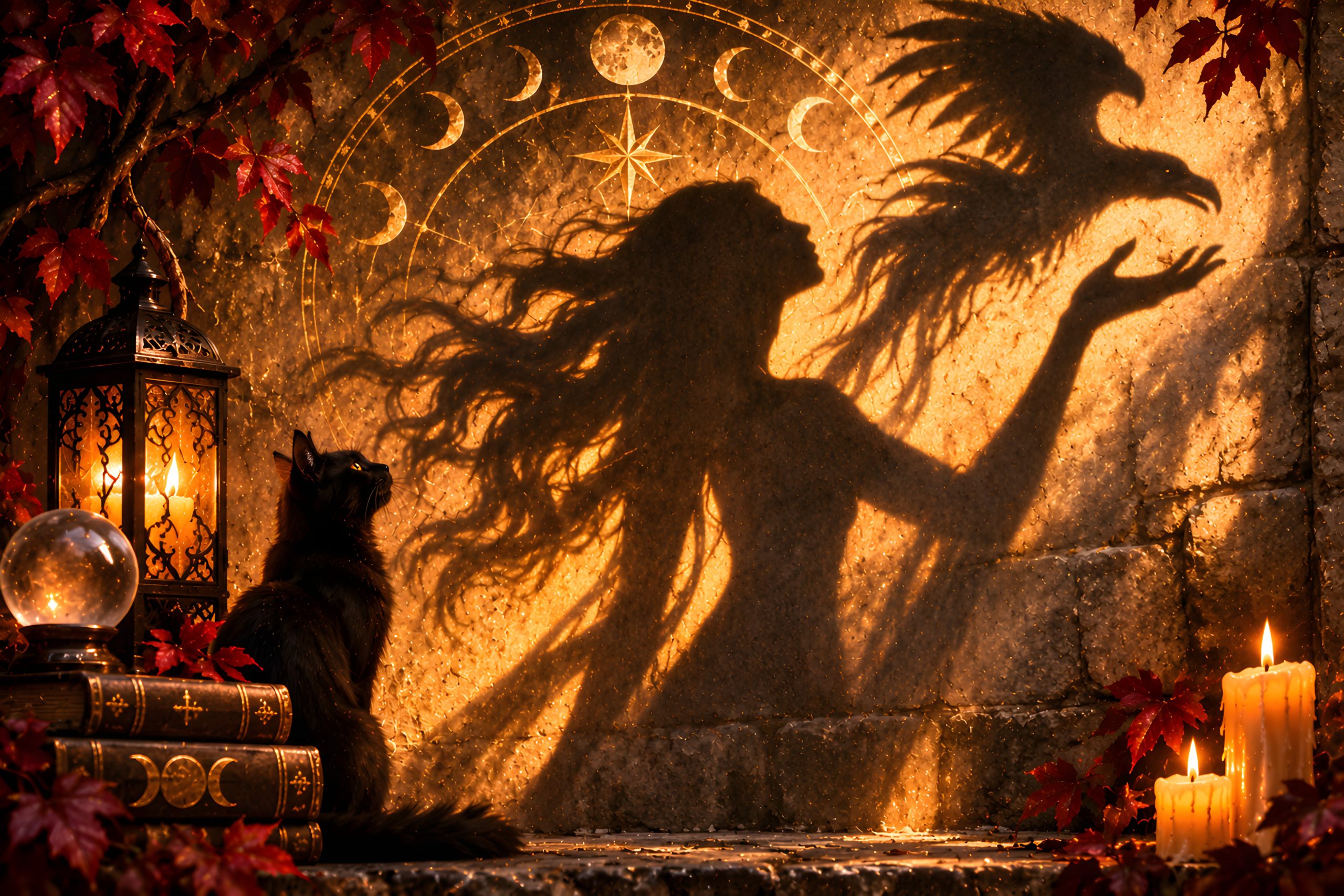

The Form Born from the Absence of Light
There is a strange phenomenon that has accompanied every living creature since the first light touched the surface of the Earth, a silent formation that follows our movements, changes its proportions, stretches across the ground, and sometimes disappears entirely, although nothing has been taken away. We call it the Shadow, yet beneath this familiar name lies one of the most peculiar manifestations of the physical world: a visible form created not by the presence of something, but by the absence of something else. Unlike the objects that surround us, a shadow possesses no substance of its own, no independent body, and no material structure that can be touched or collected. Nevertheless, it occupies a recognizable region of space, carries the outline of its source, and reveals an invisible relationship between light, matter, and the surface upon which it appears.
In the ancient language of occult symbolism, the shadow may be understood as a manifestation of the unseen through the interruption of the visible. When light encounters an object that prevents its passage, a region of reduced illumination emerges beyond it, acquiring a form determined by the position of the light, the shape of the object, and the surface receiving its projection. What appears to be a dark companion is therefore not an independent creature, but the visible consequence of an encounter between opposing conditions. Light establishes the possibility of the shadow, while matter determines its boundaries, creating an extraordinary paradox in which darkness becomes recognizable only because illumination exists around it.
Yet the shadow possesses another remarkable quality that has inspired magical and philosophical interpretations throughout human history: it is intimately connected to its source without ever being identical to it. A human body remains physically unchanged while its shadow becomes enormous beneath a low sun, contracts beneath the midday light, or dissolves into several overlapping forms when surrounded by multiple lamps. The shadow does not preserve the true proportions of the object that creates it, but expresses the relationship between that object and its surrounding conditions. In this sense, it offers a powerful symbolic lesson about perception, for what we observe is not always the complete nature of something, but the form that emerges through its encounter with the world.
This relationship becomes even more mysterious when we consider that a shadow can reveal what is otherwise difficult to perceive. The movement of celestial bodies becomes visible through shifting shadows, the passage of hours can be traced across a sundial, and the shape of an unseen object may sometimes be inferred from the darkness it casts. In astronomy, the shadows of celestial bodies contribute to the phenomena of eclipses, while in everyday life, the smallest changes in illumination can expose movements that might otherwise escape attention. Thus, the shadow is not merely a region deprived of light, it is also a carrier of information, an indirect testimony to the presence, position, and movement of something else.
Within magical traditions, shadows have often been associated with concealed identities, hidden influences, and the mysterious double of the living being. Such interpretations belong to the symbolic and spiritual imagination rather than to the physical nature of shadows themselves, yet their persistence reveals something profound about the human relationship with darkness. We instinctively recognize our own outline in the shadow, although its features are incomplete and its appearance depends upon forces beyond our control. It becomes a natural symbol of those aspects of existence that are real in their consequences but cannot always be understood through direct observation, inviting us to consider how much of what we call identity is shaped by circumstances, perspective, and the presence of others.
There is also a deeper distinction between darkness and shadow, one that transforms this ordinary phenomenon into a remarkable subject of contemplation. Darkness may exist wherever light is absent, but a shadow requires a particular relationship: a source of illumination, an obstruction, and a region where less light arrives than in the surrounding space. A shadow is therefore not simply darknes, it is darkness given structure through an encounter with light. Its boundaries reveal where illumination has been interrupted, and its existence depends upon the very force that appears to oppose it. Without light, the shadow loses its distinction from the surrounding darkness, and without matter to interrupt that light, its recognizable form cannot emerge.
Perhaps this is why the shadow remains such an enduring symbol within occult thought. It demonstrates that absence can become perceptible, that something without substance can possess form, and that what appears opposed may actually depend upon a shared relationship. The shadow does not need to be imagined as a supernatural being to carry a magical significance, for its true nature is already extraordinary: an image without a body, a form without independent matter, and a darkness that can exist as a distinct presence only within a world touched by light.
The shadow is not the enemy of illumination, nor merely its opposite. It is the hidden geometry of an encounter between light and matter, revealing that even absence may acquire a visible shape when the conditions of existence allow it.