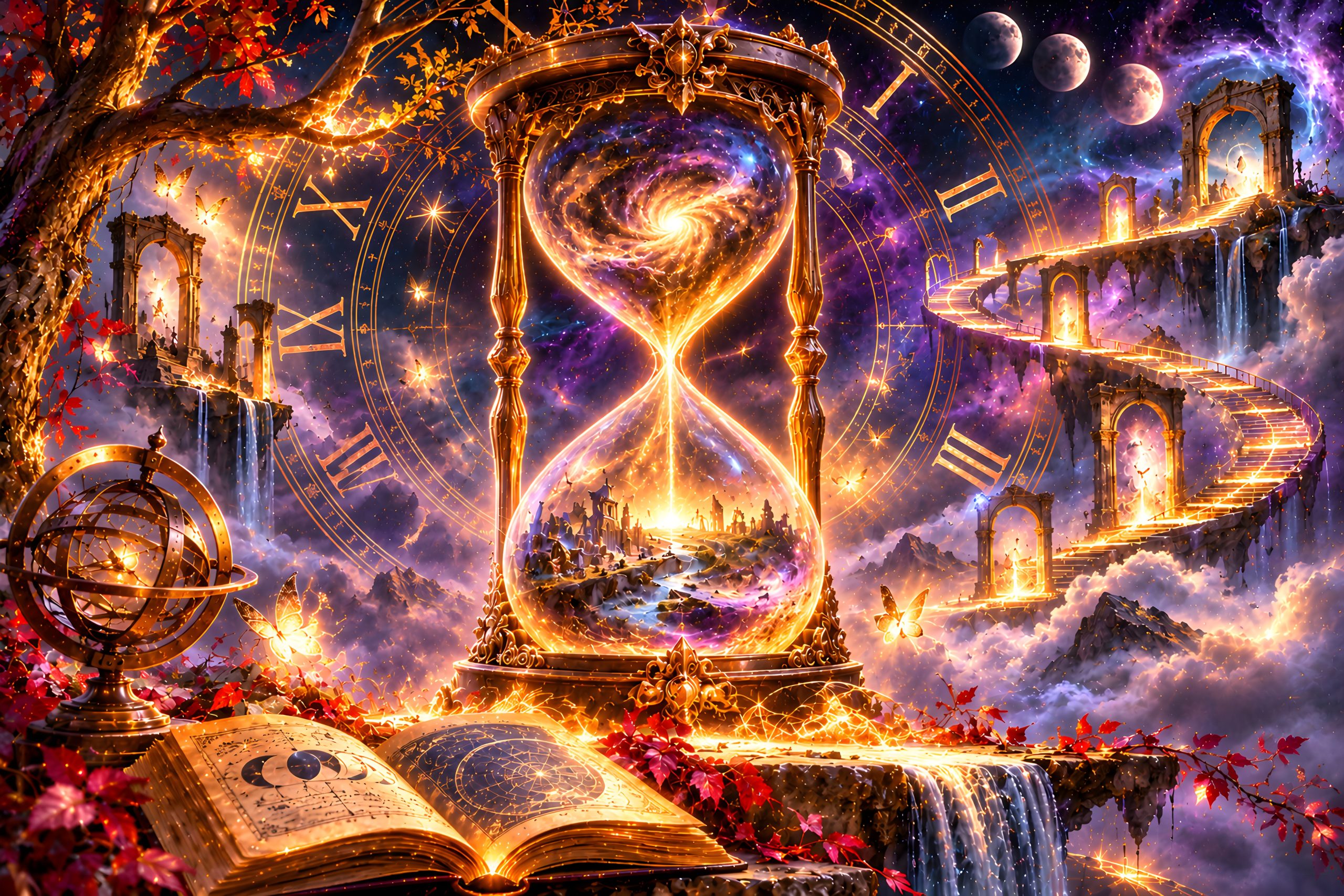

The Elasticity of the Present — The Hidden Art of Temporal Magic
Among the invisible forces that govern human existence, Time remains one of the most mysterious, for although clocks divide its passage into equal measurements, the consciousness that experiences it obeys no such perfect rhythm. A single minute may stretch into an almost unbearable eternity, while an entire evening may vanish as though it had occupied no more than a breath. This peculiar contradiction reveals a fascinating distinction between measured time and experienced time, suggesting that within the ordinary progression of hours exists another dimension of duration, one shaped by attention, emotion, memory, and awareness. In the symbolic language of temporal magic, this inner dimension may be called the Elastic Present, the mysterious interval in which consciousness does not change the movement of the clock, but transforms the depth and character of the moment it inhabits.
The ancient image of the magician standing within a circle offers an unusual way of understanding this phenomenon. A magical circle traditionally represents a boundary separating a consecrated space from the surrounding world, yet imagine applying the same principle to time rather than location. When attention becomes completely absorbed in a single experience, the ordinary sequence of concerns, expectations, and distractions may temporarily lose its authority, creating the impression that the present has expanded beyond its familiar limits. During moments of danger, intense concentration, wonder, or profound stillness, the mind may experience duration differently, as though the invisible boundaries of the moment had been drawn farther apart. The symbolic temporal circle is therefore not a prison for Time, but a sanctuary for attention, a place where the richness of experience becomes more important than the number of seconds passing beyond it.
There is another peculiar form of temporal enchantment hidden within memory. The present is never experienced entirely independently of what has already occurred, for familiar sensations can awaken earlier experiences with extraordinary intensity. A particular fragrance may suddenly restore the atmosphere of a forgotten room, a melody may revive emotions from another period of life, and an unexpected encounter may bring distant years into immediate awareness. The past has not physically returned, yet its presence can become so vivid that two different periods of existence seem to overlap within consciousness. In occult symbolism, this may be understood as the Opening of the Inner Chronos, a passage through which memory allows a vanished moment to influence the living present without reversing the actual direction of time.
The future possesses an equally curious influence, although it has not yet arrived. Through anticipation, imagination, and expectation, consciousness can respond emotionally to events that remain only possibilities. A feared encounter may occupy hours of thought before it occurs, while the promise of something beautiful may illuminate days that would otherwise seem ordinary. Here, the symbolic magician encounters the threefold nature of temporal awareness: memory carries the traces of what has passed, perception receives what is unfolding, and imagination approaches what may come. These three movements continually interact, weaving a personal experience of time that is far more intricate than the steady progression displayed upon a clock.
Yet the most fascinating secret of the Elastic Present concerns the difference between a moment that is lived and a moment that is remembered. An unfamiliar journey filled with new impressions may seem to pass quickly while it unfolds, yet appear remarkably long when recalled because it has left a rich collection of memories. Conversely, a repetitive period may feel slow while it is being endured but seem strangely brief when viewed from a distance. This contrast reveals that consciousness does not possess a single internal clock capable of describing every aspect of duration. The time we experience and the time we remember are not always the same, and within this difference lies one of the most extraordinary mysteries of the human relationship with existence.
From this understanding emerges a symbolic practice that may be called Temporal Enchantment, not as a supernatural alteration of physical time, but as the deliberate cultivation of one's relationship with the present. Imagine choosing an ordinary moment and entering it as though it were a sacred chamber, allowing the smallest details to become visible: the movement of light across a surface, the distant sounds beneath the surrounding silence, the rhythm of breathing, and the subtle changes that ordinarily escape attention. Instead of attempting to stop the passage of time, the practitioner withdraws from the constant desire to reach the next moment and begins to discover the complexity concealed within the one already unfolding. The enchantment lies in the transformation of attention, through which an apparently insignificant interval may acquire unusual richness and meaning.
Perhaps the deepest mystery of temporal magic is therefore not the possibility of commanding yesterday or imprisoning tomorrow, but the realization that the present is not experienced as a fixed and uniform possession. Every moment contains more sensations, associations, and possibilities than consciousness can ordinarily recognize, while the mind continually selects which fragments will become part of its lived reality. The clock continues its movement, indifferent to joy, sorrow, expectation, or wonder, yet the inner world transforms each measured interval into something profoundly individual.
Time may not surrender its physical laws to human desire, but the experience of Time remains one of the most mysterious territories of consciousness. The true enchantment of the present is not to make an hour last forever, but to discover how much existence can be contained within a single moment.